Alt Text in the Age of AI Search: Why It Matters More in 2026
Published Date: July 28, 2026
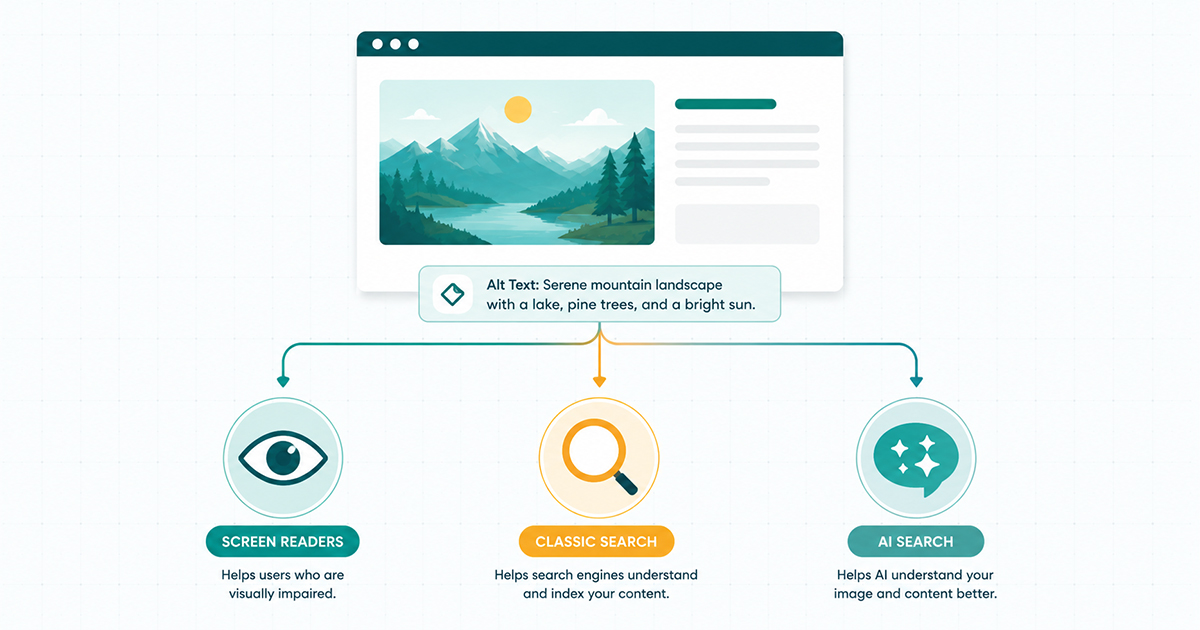
For twenty years, alt text has done two jobs. It describes an image to someone using a screen reader, and it gives search engines a text signal about what an image contains. Neither job has gone away. A third one has shown up alongside them, and it changes the stakes: AI Overviews, AI Mode, and the growing list of AI answer engines that summarize the web instead of just linking to it.
If you have been writing alt text purely as an SEO checkbox, or worse, skipping it because “Google can just look at the image now,” it is worth understanding what actually changed. Alt text for AI search is not a separate discipline from the alt text you already know how to write, it is the same habit paying off in a new place.
Search results used to be a list of ten blue links. Increasingly, they are not. Google’s AI Overviews and AI Mode generate a summarized answer directly on the results page, built from a set of pages the system decides are relevant, and then link out to those sources. The same shift is happening with standalone AI assistants that browse the web to answer a question.
Here is the part that matters for anyone managing a WordPress media library: Google’s own documentation on AI features in Search is direct about this. There are no special files, no new markup, and no AI-specific schema required to appear in AI Overviews. Standard SEO practices are what qualify a page. But the same guidance is explicit that important information needs to be “available in textual form,” and that content should be supported with quality images where relevant. Read that carefully and it is describing exactly what alt text has always been for: turning something visual into something the system can read as text.
Why alt text for AI search still matters, even when AI can see the image
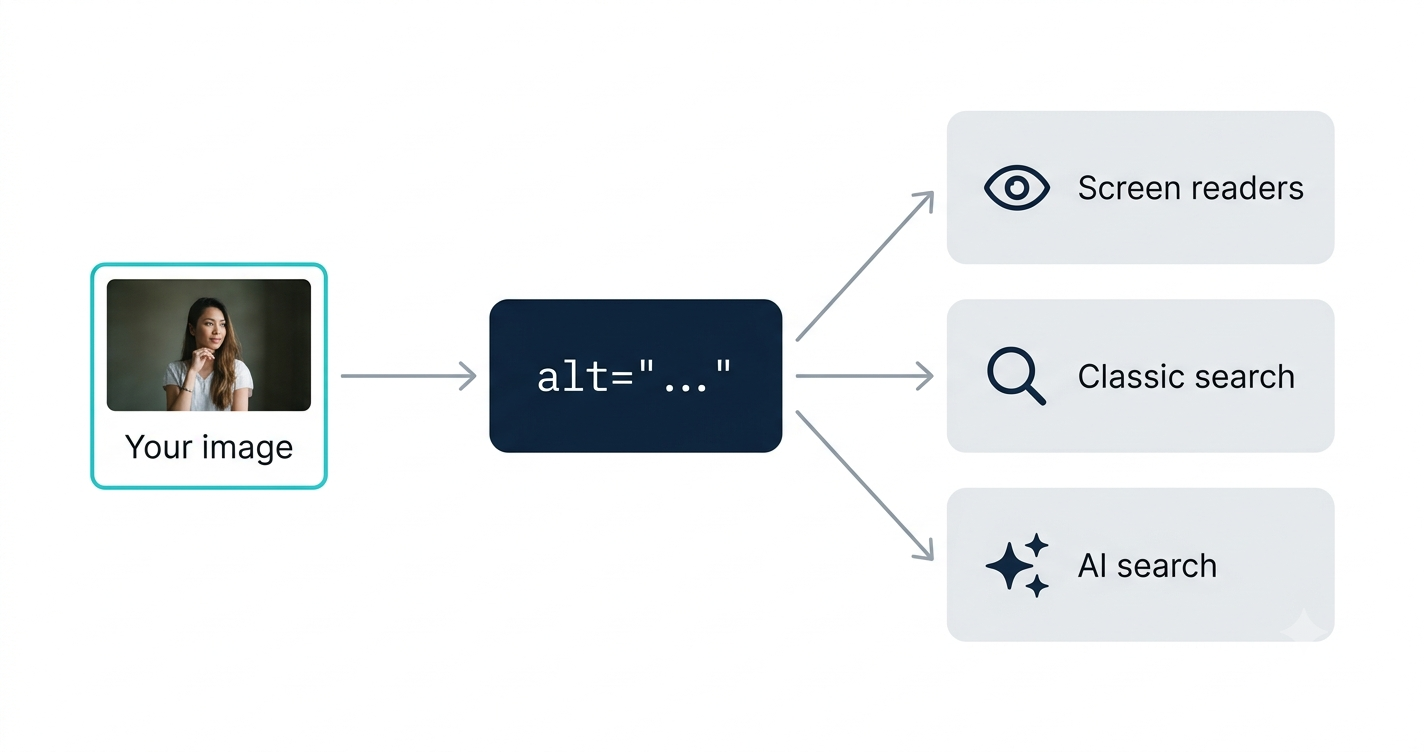
The same alt attribute already does this work. AI search is a third audience reading it, not a reason to write it differently.
This is the question worth answering directly, because it sounds like alt text should matter less now, not more.
Crawling still runs on text first – Before any answer engine analyzes an image with a vision model, its crawler has to decide the page and the image are worth that expense in the first place. That decision is made from text: the surrounding content, the alt attribute, the filename, the structured data. An image with no usable alt text can simply never make it to the stage where a vision model looks at it at all.
Alt text is a trust signal, not just a description – Even when a system can visually process an image, correct alt text confirms what the pixels actually show. That agreement between the visual content and the declared text is exactly the kind of signal a system built to avoid citing wrong or misleading information relies on. This is the same principle screen readers have depended on for two decades, extended to a new kind of reader.
Citations and image strips still need something to match against – When AI Overviews or an answer engine surfaces a supporting image alongside a summary, it is doing something close to what Google Images has always done: matching a query against text associated with an image. If you compare this to the 38% organic traffic case study on this site, the same underlying mechanism (Google reading alt text as indexed content) is what drove that result in classic search, and it is the same mechanism feeding the AI layer sitting on top of it now.
The good news: nothing about writing alt text needs to change
This is not a call to rewrite your alt text strategy for a new audience. It is confirmation that the alt text discipline you already know, description first, accuracy over keywordstuffing, one clear sentence per image, now compounds in value across every audience at once: people using assistive technology, classic image search, and AI answer engines, all reading the same attribute.
A few things do matter more than they used to:
Specific, factual detail wins – “Grey corner sofa with chaise longue, 280cm wide” gives a summarizing system something concrete to quote or match. “Sofa” or “product image” gives it nothing to work with.
Keyword stuffing is a bigger liability, not a smaller one – AI systems are built to detect unnatural, manipulated text, and alt text that reads like it was written for a ranking algorithm rather than a person undermines exactly the trust signal these systems are optimizing for. If you use AI to generate alt text, Balanced or Strict context strength will serve you better here than an aggressive SEO push.
Coverage still beats perfection – A media library where every image has accurate, if simple, alt text is more useful to every one of these systems than a library where a handful of images have beautifully crafted alt text and the rest have none at all.
What this means for a WordPress site in 2026
If your media library still has images with missing, empty, or filename-based alt text, that gap costs you in more places than it used to. It is not just a missed accessibility requirement or a missed Google Images click anymore. It is a set of images that may never surface in an AI-generated answer, a citation, or an AI-powered shopping or research assistant, simply because there was no text for the system to work from in the first place.
The fix has not changed either. Audit your library for missing or generic alt text, avoid the common mistakes that quietly produce unusable alt text even when a field is technically filled in, and for a library with more than a handful of images, bulk AI generation closes the gap in a single pass instead of a project that never quite gets finished.
FAQs
Does Google’s AI Overviews actually use alt text?
Google’s documentation on AI features in Search does not name the alt attribute
specifically, but it states that important information should be available in textual form and that content should be supported with quality images. Alt text is the mechanism that makes an image’s content available as text, so it feeds directly into that requirement, the same way it has always fed classic Google Images and web search.
Do AI assistants like ChatGPT or Perplexity read alt text when they browse a page?
When these tools browse a live page, they generally process the page’s text content, including HTML attributes like alt text, as part of understanding what is on it. Well-written alt text gives these systems accurate information about an image without requiring them to run a full vision analysis on every image on every page they visit.
Will AI search eventually make alt text unnecessary, since AI can just look at the picture?
Unlikely in the near term. Crawling and indexing at web scale still runs on text first for cost and speed reasons, and accurate alt text remains the fastest, cheapest way for any system, human or AI, to know what an image contains before deciding whether to look closer. It also remains a legal and ethical accessibility requirement independent of what AI can or cannot do.
Is optimizing for AI search different from optimizing for classic SEO?
Not for alt text specifically. The same descriptive, accurate, non-stuffed alt text that supports accessibility and classic image search is what Google’s own AI features guidance points back to. There is no separate alt text format or strategy required for AI Overviews or AI Mode.
Conclusion
Alt text for AI search is not a new skill to learn. It is the same accessibility and SEO fundamentals you already have, now serving a third audience that runs on the same signal: real, descriptive text attached to every image. Google’s own guidance on AI features in Search confirms it directly, content needs to be available in textual form, and images need to be supported well enough to be trusted. The sites that already treat alt text as a real content layer, not an afterthought, are the ones already positioned for this shift. The sites that do not are leaving the same gap they always were, just with more riding on it now.
Built on a 5-star plugin trusted by 8,000+ WordPress sites — now with AI. Pro just launched and introductory pricing won't last. Start free in 2 minutes, or lock in Pro today.